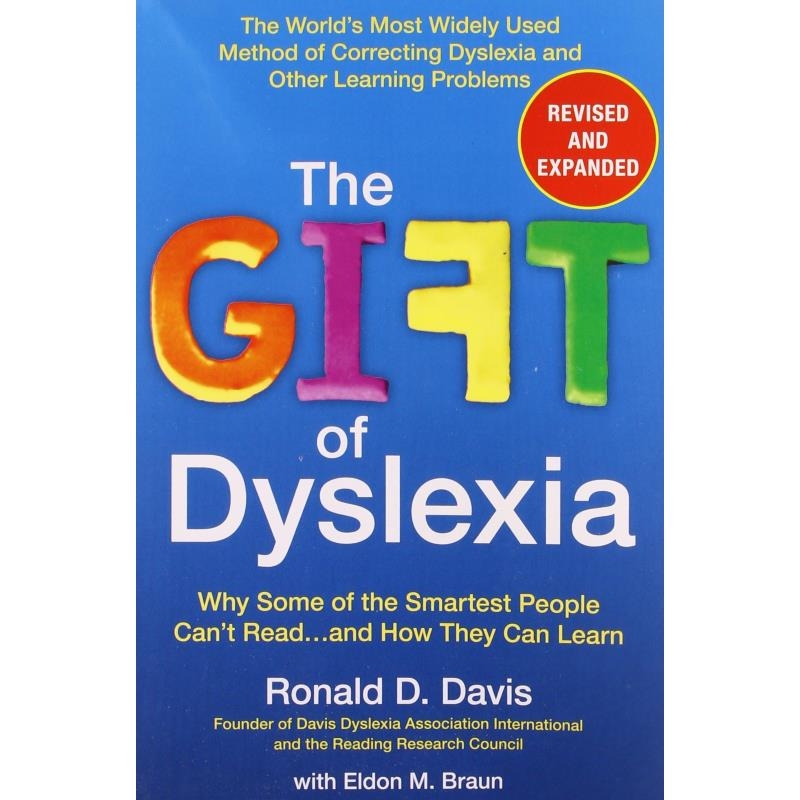
The Gift of Dyslexia:

Why Some of the Smartest People Can't Read and How They Can Learn.

By Ronald D. Davis with Eldon M.Braun.
(Perigee Books, Revised Edition, 1997)

This breakthrough book is changing the face of how dyslexia is viewed - and how it is remedied - worldwide. The revised edition contains added chapters on Spell-Read, a technique for teaching children and adults to read, use of Davis methods to overcome clumsiness, and an array of new photographs illustrating the Davis techniques.

Book Cover: The Gift of Dyslexia Buy

This book has been translated into these languages: American English | British English | Croatian | Dansk | Deutsch | Español | Français | Greek | Hebrew | Icelandic | Japanese | Italiano | Nederlands | Polski | Portuguese | Russian | Svensk


Synopsis of The Gift of Dyslexia.

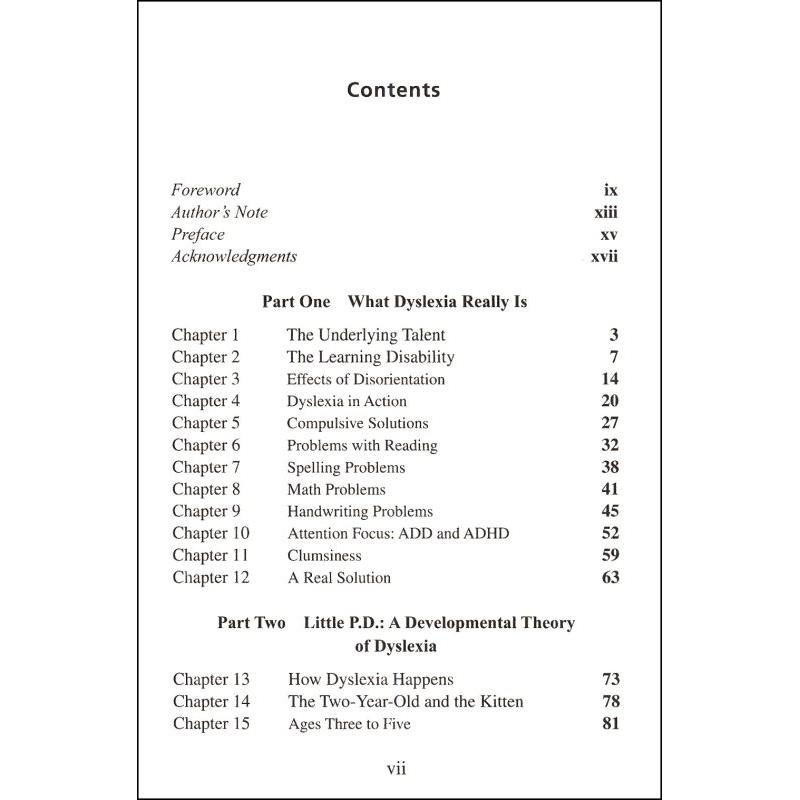
Part One: What Dyslexia Really Is

Each case of dyslexia is unique because it results from a combination of an underlying talent, or predisposition, and from environmental influences and unsuccessful learning experiences. As a result, no two dyslexics will have exactly the same set of symptoms. Ron Davis describes dyslexia as "The Mother of Learning Disabilities." He explains why many other conditions have the same root cause as dyslexia. These include Attention Deficit Disorder (ADD/ADHD), Autism, Dyscalculia/Acalculia, Dysgraphia/Agraphia, and Hyperactivity.

Part Two: A Developmental Theory of Dyslexia

Ron Davis shows how the learning disability of dyslexia is caused by the successful use of visual thinking skills at an early age. This "gift" works well for recognizing real life objects, but not printed symbols such as alphabet letters and words. Disorientation is turned on by confusion, so the stress and invalidation typically encountered during the early school years compound the problem. Mental tricks are adopted to give the appearance of learning. Loss of self-esteem causes many dyslexics to adopt ingenious methods to hide their learning disability.

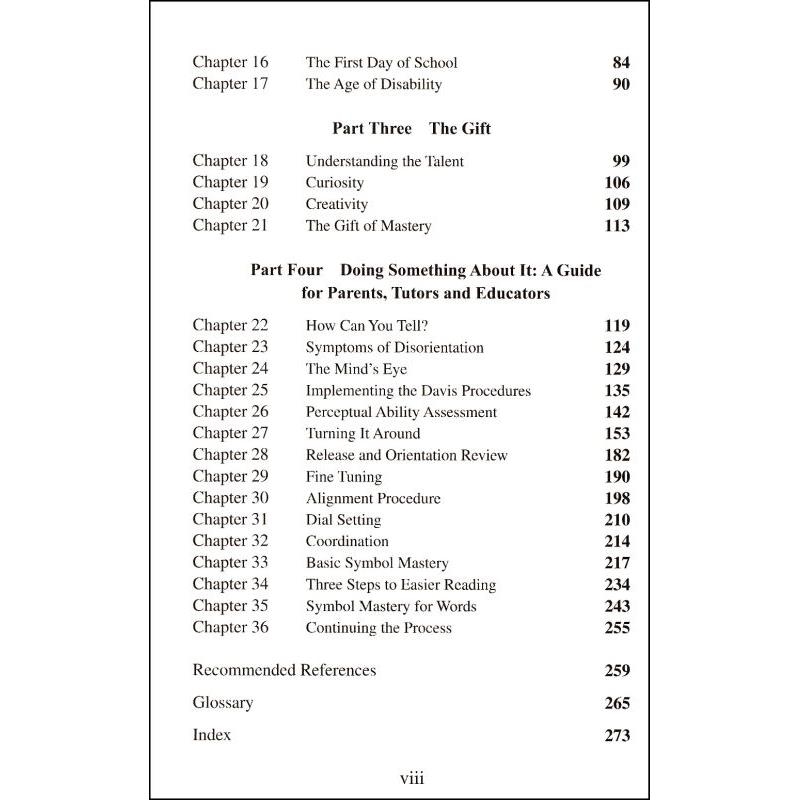
Part Three: The Gift

Ron Davis explains that multi-dimensional thinking (using all the senses) takes place much faster than verbal thinking. Dyslexics also tend to be more curious, creative, and intuitive than average. They tend to be highly aware of the environment, inventive, and good at real world tasks. Their special mode of thought also produces the gift of mastery: once they have learned something experientially, they understand it on such a deep level that they know how to do things intuitively without thinking about how.

Part Four: Doing Something About It

  • Davis Orientation Counseling: The first step of the Davis program is learning to turn off disorientation to focus the perceptions. The book explains an easily learned mental exercise that allows dyslexics to accurately recognize printed symbols.
  • Davis Symbol Mastery: Davis offers a stress-free way for dyslexics to learn the basics of written language. Students model symbols and word concepts in clay--a multi-sensory process that enables them to exercise their creativity.
  • Spell-Reading: For dyslexic students who have never been able to read, Davis presents a new approach that trains the student in left to right eye movement in reading, and helps them recognize letter groups as words.

Some Talented Dyslexics

Inventors/Engineers/Scientists:

  • Albert Einstein
  • Thomas Edison
  • Alexander Graham Bell

Artists:

  • Leonardo da Vinci
  • Walt Disney

Military/Political Strategists:

  • General George Patton
  • Winston Churchill
  • Woodrow Wilson

Performers:

  • Cher
  • Whoopi Goldberg
  • Danny Glover

Athletes:

  • Greg Louganis
  • Bruce Jenner
  • Jackie Stewart

More information about the The Gift of Dyslexia:


Dyslexia the Gift Home PageDavis Dyslexia Association International
Books & Materials: 1‑888‑999‑3324 [1‑888‑999‑DDAI]
Workshops & Licensing: 1‑888‑805‑7216
Fax: 1‑650‑692‑7075 • Local Phone: 1‑650‑692‑7141

URL: http://www.dyslexia.com
E-mail: ddai@dyslexia.com
Orders: orders@dyslexia.com
Training: training@dyslexia.com
Webmaster: webmaster@dyslexia.com
All materials on this site © 1995-2007 DDAI unless otherwise noted.

Teachers: Visit Davis Learning Strategies for tools to help all children in grades K‑3.
This Page Last Modified: Wednesday, 10 January 2007.